































- Stock: In Stock
- Brand: FESTOOL
- Model: FES205765 379923
- Weight: 0.30kg
- Dimensions: 235.00cm x 217.00cm x 11.00cm
- SKU: FES205765
- UPC: 4014549390382
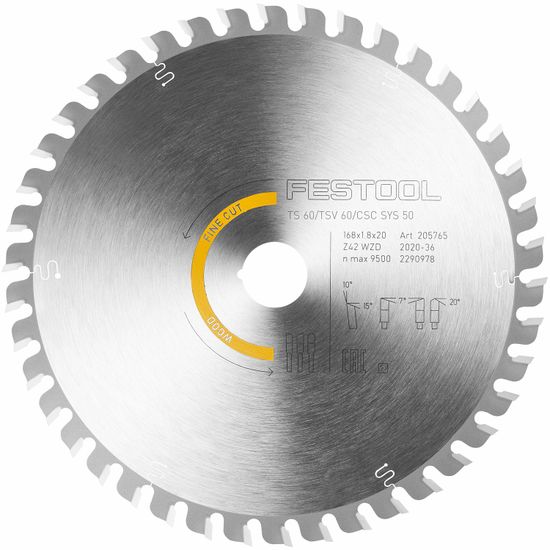
Festool HW 168x1,8x20 WD42 WOOD FINE CUT Saw Blade
At a Glance: Premium 168 mm carbide-tipped WOOD FINE CUT saw blade with 42 teeth, 1.8 mm cutting width and 20 mm bore, engineered for exceptionally clean, low-splinter cross-cuts in solid timber, veneered panels, coated boards and MDF.
When the finished edge really matters, the Festool HW 168x1,8x20 WD42 WOOD FINE CUT is the blade designed to deliver it. Developed specifically for the Festool TS 60 K, TSV 60 K and CSC SYS 50, this premium 168 mm fine-cut circular saw blade combines a slim 1.8 mm kerf with 42 precision carbide teeth to produce clean, controlled and impressively low-splinter cuts. It is an excellent choice for furniture manufacture, cabinetry, kitchen installation, panel sizing and cross-cutting solid timber where a high-quality finished edge is essential. The specialised WD tooth geometry combines alternating cross-cut teeth with a relieving roof or trapezoidal-style tooth. This reduces the cutting load on the principal teeth, promotes exceptionally smooth running and contributes to a long service life. High-quality fine-grain carbide cutting edges retain their sharpness through demanding professional use, while the blade geometry, cutting angle and tooth form have been carefully matched to the compatible Festool machines. Whether cutting veneered sheet goods, coated furniture panels, MDF or solid timber across the grain, this WOOD FINE CUT blade is built to turn the precision of your Festool saw into beautifully finished cuts.
Festool's WOOD FINE CUT blades are designed for applications where cut quality takes priority. The higher tooth count and application-specific tooth geometry produce a finer cut than general-purpose or rip-cut blades, making this blade particularly suitable for cross-cutting solid timber and sizing high-quality veneered or coated panels. The 1.8 mm cutting width also reduces the amount of material removed, lowering cutting resistance and helping compatible Festool saws work efficiently.
Product highlights
- WOOD FINE CUT specification: Developed for clean, low-splinter cross-cuts and precision panel cutting where finished edge quality is important.
- 168 mm blade diameter: Correct blade size for the Festool TS 60 K, TSV 60 K and CSC SYS 50.
- 42 precision teeth: High tooth count produces a fine, controlled cutting action for excellent finished surfaces.
- WD tooth geometry: Combines cross-cut teeth with a relieving roof or trapezoidal-style tooth to improve smoothness and blade life.
- 1.8 mm cutting width: Slim kerf reduces cutting resistance, material loss and power demand.
- 20 mm bore: Precisely matched to the spindle system of the compatible Festool saws.
- Fine-grain carbide teeth: High-quality carbide cutting edges provide excellent durability and consistently accurate cutting performance.
- Excellent cut quality: Engineered to produce clean and low-splinter edges in demanding furniture and interior-fitting applications.
- Ideal for coated panels: Particularly effective for furniture boards and other panel materials where visible surfaces require a clean finish.
- Excellent for veneered materials: Fine tooth geometry helps minimise breakout on delicate veneer surfaces.
- Designed for MDF: Provides accurate, refined cuts in MDF and similar wood-based sheet materials.
- Excellent solid-wood cross-cuts: The blade geometry is optimised for cutting cleanly across the grain.
- Smooth-running design: The relieving tooth geometry reduces loading on the alternating teeth and contributes to controlled, even running.
- Long service life: Premium carbide teeth and carefully matched geometry provide excellent wear resistance.
- Festool colour coding: The WOOD FINE CUT colour identification makes selecting the correct blade for the application quicker and easier.
- Machine-specific engineering: Tooth form, cutting angle, kerf and blade dimensions are designed specifically around the compatible Festool saw system.
Product Compatibility
- Festool TS 60 K: Fully compatible with the TS 60 K plunge-cut saw and optimised for precision fine-cutting applications.
- Festool TSV 60 K: Compatible with the TSV 60 K plunge-cut saw system for high-quality panel and timber cutting.
- Festool CSC SYS 50: Compatible with the CSC SYS 50 cordless table saw for precise workshop and mobile fine-cut applications.
Compatibility note: Always use the saw blade only on machines specified for a 168 mm blade with a 20 mm bore and compatible 1.8 mm cutting width. Do not assume compatibility with other Festool saws simply because the bore diameter is the same.
Unlimited Blocks, Tabs or Accordions with any HTML content can be assigned to any individual product or to certain groups of products, like entire categories, brands, products with specific options, attributes, price range, etc. You can indicate any criteria via the advanced product assignment mechanism and only those products matching your criteria will display the modules.
Also, any module can be selectively activated per device (desktop/tablet/phone), customer login status and other criteria. Imagine the possibilities.
Features
- 168 mm diameter: Precisely dimensioned for compatible Festool plunge-cut and table saws.
- 1.8 mm cutting width: Narrow kerf promotes efficient cutting with reduced resistance.
- 1.2 mm blade body thickness: Provides an excellent balance between stability and a narrow cutting kerf.
- 20 mm arbor bore: Accurate fit on the intended Festool machines.
- 42 teeth: High tooth count optimised for fine cross-cutting and quality panel work.
- WD tooth form: Specialised tooth geometry designed for smooth running, fine cutting and extended service life.
- 10° hook angle: Carefully chosen cutting geometry supports controlled, precise material engagement.
- 15° clearance angle: Optimised tooth relief contributes to efficient cutting and clean chip clearance.
- Fine-grain carbide: Durable carbide cutting edges maintain sharpness and cutting quality over extended professional use.
- High-quality steel blade body: Provides the dimensional stability required for accurate Festool cutting systems.
- Application-specific design: Tooth geometry and cutting angles are matched to the intended materials and compatible Festool machines.
- Colour-coded application system: Helps identify the blade quickly as part of Festool's WOOD FINE CUT range.
- Resharpenable carbide teeth: The blade can be professionally resharpened, extending its useful working life when tooth condition permits.
Benefits
- Beautiful finished edges: The 42-tooth fine-cut geometry helps produce smooth surfaces that require minimal additional finishing.
- Reduced splintering: Application-specific tooth geometry provides excellent results on coated and veneered sheet material.
- Excellent cross-cut performance: Ideal for cutting solid timber cleanly across the grain.
- Efficient cordless cutting: The slim 1.8 mm kerf reduces the amount of material being removed, helping minimise cutting resistance on the CSC SYS 50.
- Less material waste: A narrow kerf removes less material with every cut compared with wider blades.
- Smooth machine operation: The WD tooth arrangement spreads the cutting load effectively and promotes stable running.
- Long usable life: Premium carbide teeth resist wear and can be professionally resharpened when appropriate.
- Consistent accuracy: The high-quality blade body and machine-matched geometry complement the precision of Festool's saw systems.
- Faster blade selection: Festool's colour coding helps users identify the appropriate blade for fine wood cutting at a glance.
- Professional panel results: Particularly useful where a cut edge will remain visible in furniture, cabinetry or kitchen installations.
Application
- Fine cross-cuts in solid timber.
- Cutting veneered panels.
- Cutting coated furniture panels.
- Cutting MDF.
- Precision panel sizing.
- Furniture manufacture.
- Cabinetmaking.
- Kitchen manufacturing and installation.
- Interior fitting and joinery.
- Cutting finished sheet materials where low splintering is important.
- Precision cross-cutting with the Festool TS 60 K.
- Fine cutting with the Festool TSV 60 K.
- Precision table-saw work with the Festool CSC SYS 50.
Extra Information
- What does WOOD FINE CUT mean? WOOD FINE CUT identifies Festool blades optimised for especially clean cross-cuts in solid timber and for accurately cutting coated or veneered sheet material. The tooth count and geometry prioritise finish quality over aggressive ripping speed.
- What does 168x1,8x20 mean? The designation describes the three critical blade dimensions: 168 mm outside diameter, 1.8 mm cutting width or kerf, and a 20 mm centre bore.
- What does WD42 mean? WD identifies the blade's specialised fine-cut tooth geometry, while 42 indicates that the blade has 42 cutting teeth.
- Special tooth arrangement: In addition to alternating cross-cutting teeth, the blade incorporates a relieving roof or trapezoidal-style tooth. This reduces the workload on the alternating teeth and promotes smoother operation and longer service life.
- Why 42 teeth? A higher tooth count means more cutting edges engage the material during each revolution. This generally produces a finer surface and less breakout than a low-tooth-count ripping blade.
- Why a 1.8 mm kerf? The narrow cutting width reduces the volume of material that needs to be removed. This lowers cutting resistance, improves efficiency and produces less waste.
- 1.2 mm blade body: The steel body is thinner than the 1.8 mm cutting width so the teeth create clearance around the blade body during the cut.
- 10° hook angle: The moderate positive cutting angle gives the blade a controlled cutting action suitable for precision work and fine cross-cuts.
- Fine-grain carbide: Festool uses high-quality carbide for the cutting teeth to provide a combination of edge retention, durability and accurate cutting.
- Resharpening: When tooth wear eventually affects cutting quality, a professional saw-blade sharpening service can restore the carbide cutting edges where sufficient tooth material remains.
- Choose the right blade for the job: This blade excels at fine cross-cutting and panel work. For fast ripping along the grain or cutting specialised materials such as laminate, aluminium or abrasive boards, use the corresponding Festool application-specific blade.
The correct blade can make a dramatic difference to both cutting speed and finished quality. A rip-cut blade uses fewer, more aggressive teeth to remove material rapidly along the grain. A universal blade balances cutting speed and finish for general work. The 42-tooth WOOD FINE CUT blade places greater emphasis on finished-edge quality, making it the preferred choice for visible cross-cuts, veneered boards, coated furniture panels and precision cabinetry.
Pro Tips
- Choose this blade when the finished cut edge will be visible or when reducing splintering is more important than achieving the fastest possible feed rate.
- For solid timber, use the WOOD FINE CUT blade primarily for cross-cuts. A dedicated rip-cut blade is generally more efficient when making long cuts along the grain.
- Keep the blade clean. Resin and adhesive deposits on the carbide teeth can increase friction, create heat and make a sharp blade behave as though it is blunt.
- Do not force the saw through the material. A smooth, controlled feed allows all 42 teeth to cut efficiently and gives the best surface finish.
- When cutting veneered or coated boards, make sure the blade is sharp and correctly installed before beginning an important finished component.
- Use the Festool guide rail and splinter guard correctly with compatible plunge saws to take full advantage of the blade's low-splinter cutting capability.
- Replace a worn guide-rail splinter guard if it no longer aligns closely with the saw blade. A fine-cut blade cannot compensate for a damaged or badly positioned guide system.
- Check the blade for resin build-up before assuming that it requires sharpening. A properly cleaned carbide blade can often recover noticeably better cutting performance.
- Have carbide blades sharpened by a professional service familiar with the original tooth geometry. Incorrect grinding angles can permanently alter cutting performance.
- Do not wait until the blade becomes extremely blunt before sharpening. Continued operation with dull teeth increases heat and cutting forces and can accelerate wear.
- When cutting expensive finished panels, make a test cut in an offcut first to confirm blade condition, machine setup and finished-edge quality.
- Use appropriate dust extraction with the saw to improve visibility, keep the cutting system cleaner and reduce airborne dust.
How to Use
- Disconnect the mains-powered saw from the electrical supply or remove the battery packs from a cordless saw before changing the blade.
- Confirm that the machine is approved for a 168 mm diameter blade with a 20 mm bore and the required 1.8 mm cutting width.
- Inspect the blade carefully for cracked carbide teeth, distortion, damage or excessive wear before installation.
- Activate the saw's spindle lock and remove the existing blade according to the machine operating instructions.
- Clean the spindle, flange and blade-contact surfaces before fitting the new saw blade.
- Install the HW 168x1,8x20 WD42 with the blade rotation direction correctly aligned with the direction indicated on the saw.
- Refit and tighten the blade flange and retaining screw to the machine manufacturer's specification.
- Check that the blade rotates freely and that all guards and covers are correctly refitted before reconnecting power.
- Set the cutting depth so the blade projects only as far through the material as required for safe and efficient cutting.
- Support and secure the workpiece correctly before beginning the cut.
- Start the saw and allow it to reach operating speed before feeding the blade into the workpiece.
- Guide the saw smoothly through the cut without forcing or twisting the blade.
- Allow the blade to come to a complete stop before removing offcuts or making adjustments.
- Clean the blade periodically and inspect the carbide teeth to maintain optimum cutting quality.
Specifications
| Description | Spec |
|---|---|
| Brand | Festool |
| Cat No. | FES205765 |
| Festool Order No. | 205765 |
| Product Type | Fine Cut Circular Saw Blade |
| Model | HW 168x1,8x20 WD42 |
| Blade Range | WOOD FINE CUT |
| Blade Material | High-Quality Steel with Carbide Teeth |
| Blade Diameter | 168 mm |
| Cutting Width / Kerf | 1.80 mm |
| Blade Body Thickness | 1.20 mm |
| Bore Diameter | 20 mm |
| Number of Teeth | 42 |
| Tooth Shape | WD |
| Hook / Chip Angle | 10° |
| Clearance Angle | 15° |
| Primary Application | Fine Cross-Cutting and Panel Cutting |
| Suitable Materials | Solid Wood, Veneered Panels, Coated Panels, MDF |
| Compatible Machines | TS 60 K, TSV 60 K, CSC SYS 50 |
| Resharpenable | Yes, by a suitable professional sharpening service |
| Quantity | 1 Piece |
Scope of Delivery:
- 1 x Festool HW 168x1,8x20 WD42 WOOD FINE CUT saw blade
Safety
- Wear suitable eye, hearing and respiratory protection whenever operating a circular, plunge-cut or table saw.
- Use the blade only with saws specifically approved for its 168 mm diameter, 20 mm bore and cutting-width specification.
- Disconnect the saw from its mains supply or remove the battery packs before fitting, removing, cleaning or inspecting the blade.
- Check the saw blade before every use for damaged, cracked, missing or severely worn carbide teeth.
- Never use a blade that is warped, cracked or otherwise structurally damaged.
- Install the blade in the correct rotational direction as indicated on the blade and machine.
- Make sure the spindle flange and blade-contact surfaces are clean and correctly seated before tightening the blade.
- Use all guards, riving knives and safety devices specified for the machine and application.
- Secure and support the workpiece correctly to prevent movement, binding or kickback during the cut.
- Never force, twist or side-load the blade during cutting.
- Do not exceed the maximum rotational speed marked on the blade or specified by Festool.
- Keep hands and body parts clear of the cutting path and never reach near or behind a rotating blade.
- Allow the blade to reach operating speed before entering the workpiece.
- Wait until the blade has stopped completely before removing offcuts, making adjustments or setting the machine down.
- Wood dust and dust from MDF, coatings and manufactured boards can be harmful. Use suitable dust extraction and respiratory protection appropriate to the material.
- Have carbide saw blades resharpened or repaired only by suitably qualified professionals who can maintain the original blade geometry and safety requirements.
- Read and follow the Festool saw, saw-blade and workplace safety instructions before use.